Who gets to find what someone else lets go?
01 · The problem space
An object doesn’t stop being valuable when its first owner is finished with it. Yet the systems that make new products easy to discover, compare, and purchase rarely make it equally convenient to find what already exists.
Cirkular began by investigating that distance between intention and action, and the realization that sustainability needed more than better information. It needed a different relationship with attention, culture, convenience, and desire.
02 · Research at Cornell
Willingness wasn’t missing. Shopping architecture was.
Cirkular emerged from a collaborative Human-Computer Interaction Studio project at Cornell University in Fall 2024.
Working alongside Kacey Kim, Emma Chase, and Canaan Delgado, we investigated the relationship between consumers’ environmental attitudes and their actual purchasing behavior.
Our initial survey revealed an interesting contradiction: 21 of 30 respondents expressed willingness to thrift or reduce their reliance on fast fashion. The opportunity was apparent, but so were the barriers.
The challenge wasn’t necessarily a lack of environmental awareness. It was that the architecture of online shopping made one behavior easier than the other. That distinction shaped our first intervention: rather than asking users to adopt an entirely new shopping destination, we explored introducing secondhand alternatives at the moment they were already considering a purchase.
The intervention was small, but its implications were larger: the interface through which a decision is made can influence which possibilities are considered at all.
03 · From research to interaction
Bringing secondhand into the moment of purchase.
Our initial browser-based prototype brought secondhand discovery and sustainability information directly into the existing shopping journey.
The interface presented comparable products, potential cost savings, environmental impact estimates, and sustainability grades alongside the item a user was considering.
Sustainability Alert!
This product’s sustainability score could impact your goal to reduce carbon footprint by 30% this year
Mistaken for an advertisement
The initial corner card was compact enough to appear while browsing, but its banner silhouette and red warning palette caused participants to mistake it for a pop-up ad or store redirect.
Prominent, yet exposed deeper credibility & utility gaps
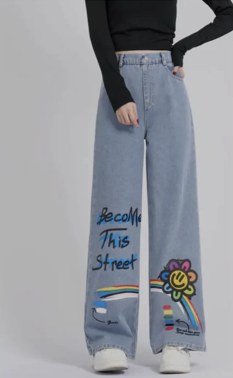
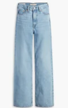
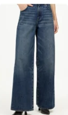
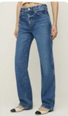
Expanding into a side-by-side comparison solved visibility, but participants immediately asked for sizing and budget filters ($80–$168 alternatives broke a $29.99 budget) and questioned how cost-per-use and labor figures were calculated.
Usability testing exposed a tension between the information we wanted to communicate and the practical constraints users actually needed to satisfy. Introducing sustainability information inside a live purchase raised a deeper problem.
What makes an environmental claim credible enough to influence a purchase?
04 · Questioning authority and credibility
When a single score hides the evidence behind it.
We developed KORE as an evaluation framework organized around four connected dimensions—exploring how products could be assessed against an idealized sustainable benchmark rather than judged exclusively through price, popularity, or a brand’s own claims.
Testing revealed which questions the four dimensions could answer and why we retired the single grade.
Durability
Less than half the benchmark.
- This listing
- ~20washes
- KORE benchmark
- 50+washes
A shorter wash life could mean replacing the garment sooner.
Carbon footprint
About 3.5× the benchmark (estimate).
- This listing
- 10kg CO₂
- KORE benchmark
- 2.85kg CO₂
The prototype estimated higher emissions, with no listing-level data to confirm them.
Water use
An estimated 7,500 liters more.
- This listing
- 10,000liters
- KORE benchmark
- 2,500liters
The prototype projected higher water use, with no listing-level data to confirm it.
Transparency
Factory and labor details unknown.
- This listing
- No data availableSupply chain
- KORE benchmark
- Full certificationSupply chain
The listing gave shoppers no way to verify where or how the garment was made.
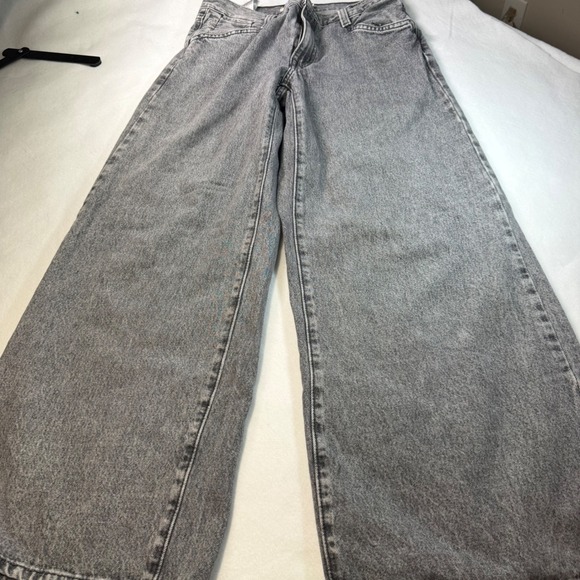
Levi’s ’94 Baggy
Gray wash · Wide leg
$26- Tagged size
- 28
- Inseam
- 31″
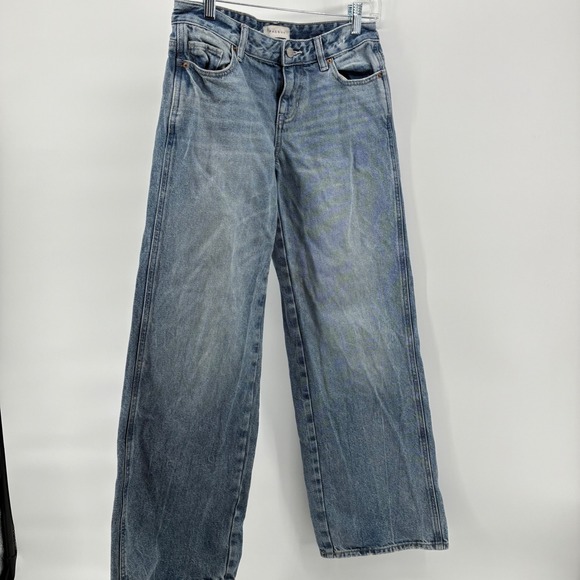
PacSun Wide Leg
Light wash · Wide leg
$18- Tagged size
- 28
- Inseam
- 30″
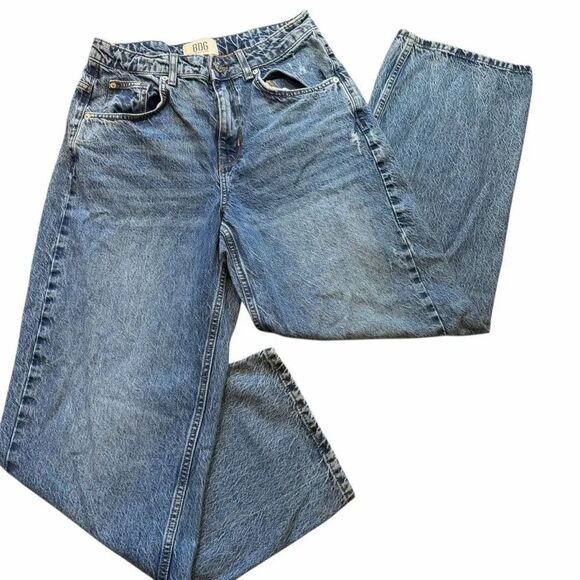
BDG Acid Wash
Blue wash · Wide leg
$21- Tagged size
- 28
- Inseam
- 30″
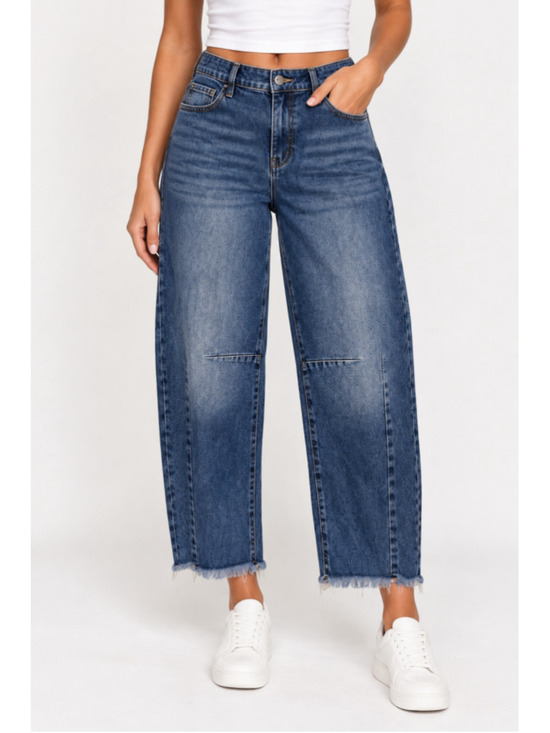
Ashley Mason Barrel
Medium wash · Barrel leg
$40- Tagged size
- 28
- Inseam
- 28″
Assessing material construction beyond brand marketing
- Prototype measured
- Design assumption
- Testing revealed
Missing factory records had counted against durable garments. Separate dimensions let missing evidence stay Unknown.
Taking the scoring problem to cognitive science and cultural theory
Because the credibility breakdown went deeper than interface layout, we brought the prototype to two Cornell scholars whose work directly challenged how Cirkular treated authority, evidence, and human motivation.
Shimon Edelman
Does collapsing environmental metrics into a single A–F grade and carbon-credit rewards help shoppers make better decisions?
A simplified score projects false authority while hiding the reasoning and missing data behind it. Gamified points and carbon credits distract from reflective purchasing.
Retired the single Grade D, stripped out points and leaderboards, and kept KORE’s four dimensions separated so missing evidence is explicitly marked Unknown.
Caroline Levine
Why do detailed environmental impact tables so often fail to move people from awareness into action?
Overwhelming people with impact data without a meaningful sense of agency produces climate fatigue. Communication must shift from lecturing individuals to inclusive storytelling and collective action.
Expanded beyond utility metrics into cultural desire, the Cirkular Manifesto, and shared participatory systems like Digital Compost and campus reuse infrastructure.
Together, usability testing and faculty critique shifted the question from how much sustainability information an interface could display to how effectively it supported judgment, trust, and action. We stripped away gamified rewards, social-sharing mechanics, and a separate mobile experience—yet refining the interface exposed a deeper limit.
05 · From information to cultural desire
A product could make alternatives easier to find without necessarily making people want them.
That realization opened the next investigation: sustainability’s cultural language.
Much of the familiar visual vocabulary of environmental initiatives is built around reassurance—earthy palettes, natural imagery, muted typography, and language emphasizing individual responsibility. Environmental urgency is difficult to reconcile with communication designed to feel consistently gentle and unobtrusive.
As I took creative leadership over Cirkular’s subsequent development, sustainability was competing for attention inside an environment already saturated by fashion, entertainment, and advertising. Instead of adopting conventional eco-reassurance, I studied how contemporary culture makes an idea instantly recognizable, shareable, and impossible to ignore.
How one fluorescent green escaped an album and became a public signal

Stripped-back typography and an unapologetic lime green refused conventional polish—making the color itself the mark.
Charli XCX, Brat (Atlantic Records, June 2024). Art direction: Special Offer / Brent David Freaney. Public domain textlogo via Wikimedia Commons.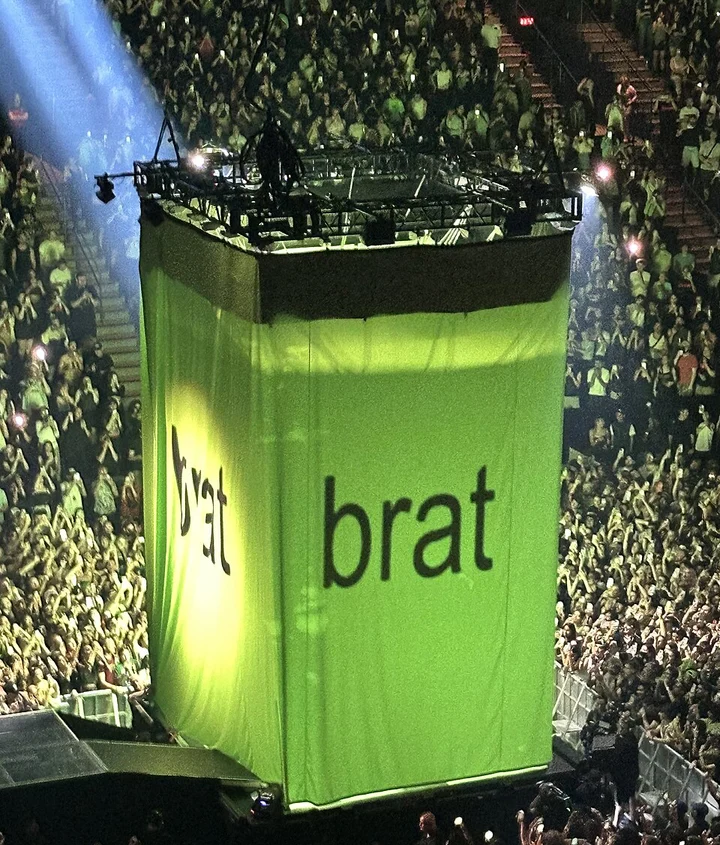
The signal jumped off screens into fashion, physical architecture, and arena crowds—instantly legible from across a room.
Brat Tour, Place Bell (Sept 16, 2024). Photo: MChloeLB, CC BY-SA 4.0 via Wikimedia Commons.
Within weeks, the exact color code crossed from pop music into national politics and everyday feeds—proof that people remix signals they feel invited into.
Kamala HQ X banner (July 2024). Harris for President. Public domain via Wikimedia Commons.The takeaway wasn’t to copy an album cover. It was that green didn’t have to whisper to speak about the environment.
Where BRAT used lime green for club-culture provocation, Cirkular fused that cultural charge with sustainability’s own green—disciplining it through black-and-white Swiss contrast, the original Cirkular lettering, and 1-bit visual transformation.
Cirkular paired lime’s cultural charge with Swiss black-and-white contrast, original lettering, and 1-bit imagery.
06 · The Cirkular identity
Green without reassurance.
Repositioning green as an urgent cultural signal required three disciplined constraints: high-voltage contrast, structural typography, and transformed imagery.
- Acid green #BBFF29
- White #FFFFFF
- Black #000000
The research established the behavioral problem. The identity became a creative response to its cultural implications.
07 · From identity to world
“Our creativity is a survival strategy.”
The Manifesto positioned imagination, reclamation, and collective participation as ways of reconsidering our relationship with consumption.
Our phones had become places of constant accumulation—photographs, videos, screenshots, and files endlessly created and stored, their material consequences hidden behind frictionless feeds.
Rather than building another newsletter or conventional feed, I began developing an experience where people could participate in Cirkular’s ideas through the digital material they already consumed.
08 · Digital Compost
Dithering turns excess into essence, removing detail, but never meaning.
Digital Compost reimagined image-sharing as an experiment in creative restraint—applying the same sustainability logic from physical products to the weight of everyday files.
The same acid green defining Cirkular’s identity became the visual language through which uploaded photos and videos were transformed. Every dithered piece circulated Cirkular directly inside the digital spaces where people already shared media—building recognition through participation rather than advertising.
In testing the application, transformed images reached approximately 4% of their original file size—connecting digital weight reduction with a distinctive graphic form.
Its collective gallery rejected individual profiles, follower counts, and popularity rankings in favor of temporary shared discovery:
What began as a question about the sustainability of digital files had become an investigation into the design of digital culture itself.

09 · Cornell and circular infrastructure
Circularity beyond the screen.
Cirkular’s exploration of participation also extended back into the physical environment where the project began.
At Cornell, students regularly leave behind usable belongings between academic years. The university’s existing Dump & Run program recovers those goods, revealing an opportunity to keep their value circulating continuously inside campus life.
Through direct work and discussions with Cornell’s Office of Sustainability, I developed a partnership proposal exploring how existing institutional resources could support continuous reuse and student-led environmental experimentation.
Move-Out Surplus
Usable belongings left behind by students between academic years.
Dump & Run
University recovery program coordinated with Cornell’s Office of Sustainability.
Cirkular Store
Proposed continuous secondhand access connecting recovered campus goods back to students.
Cirkular Incubator
Proposed space for student-led environmental experimentation and circular prototyping.
Although the proposed Store and Incubator were not fully implemented, the collaboration established a direction for exploring sustainability beyond individual transactions.
Cirkular was becoming a system in which technology, culture, and community could reinforce the same change in consumption.
10 · Returning to the original intervention
The world changed the product.
Cirkular began as a just-in-time browser plug-in for finding secondhand alternatives while you shop. The first version asked people to take in too much before they could act.
The final plug-in starts in gray so it can appear quietly while someone shops. The circular form carries Cirkular’s identity into the open pill, where black and lime frame the recommendations.
From alert to recommendation
How the plug-in changed
2024 prototype
Sustainability Alert!
This product’s sustainability score could impact your goal to reduce carbon footprint by 30% this year
View AnalysisIn testing, shoppers mistook the alert for an ad or redirect.
Final plug-in

The small gray circle stays unobtrusive at the edge.
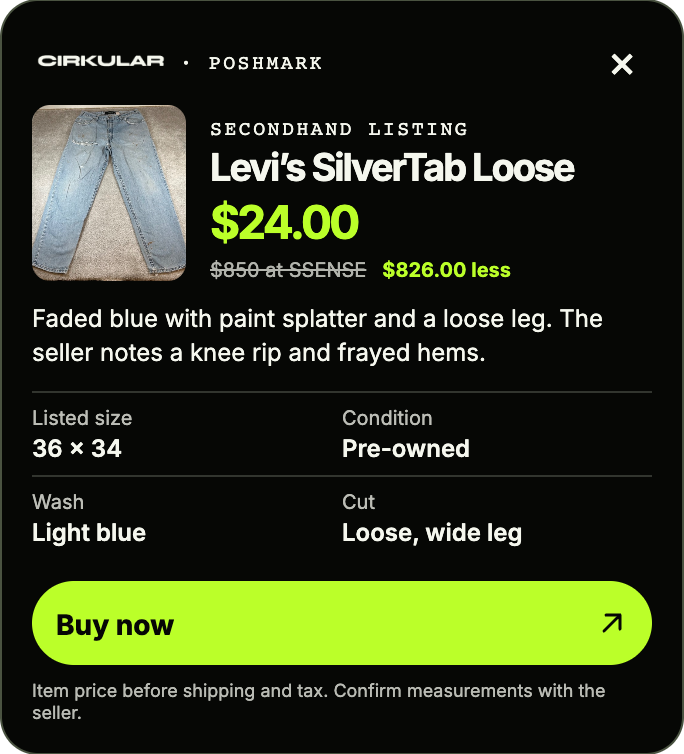

The round launcher extends into a rail of round photos.
The listing opens on black. Lime draws attention to price and action.


Item information
Terracotta cotton knit with dropped shoulders, side vents, and a logo patch at the back of the collar.
- Composition
- 100% cotton
- Made in
- China
- Product code
- 252129F096004
Choose a photo for details. Tap or click the C to close or reopen.
KORE Evaluation
The example card shows what supports a C grade.
Item analysis
Why a C?
The listing gives us the fabric and country of manufacture. Factory practices and wear-test evidence are unknown.
- Quality
- Rib-knit fabric. The retailer lists 100% cotton.
- Production
- Made in China. Factory and labor practices undisclosed.
- Durability
- Unknown. No wear-test or repair data in the listing.
- Transparency
- Fabric and origin are disclosed. Supplier details are missing.
Example grade · Evidence from the SSENSE listing
- Why this grade?Start with what the listing tells us and the evidence we’re missing.
- Four dimensionsQuality, production, durability, and transparency each show what supports the assessment.
- Source and limitsThe source stays visible and the grade is marked as an example.
11 · From intervention to delegation
What happens when the shopper no longer begins with a product page?
The browser plug-in meets people while they shop. A future agentic Cirkular could meet them before the search begins. Someone could describe what they need and delegate the work of finding, evaluating, and comparing secondhand options.
KORE’s research could inform how an assistant evaluates a find alongside fit, condition, price, and availability. Gaps in listing details and environmental evidence would stay visible.